
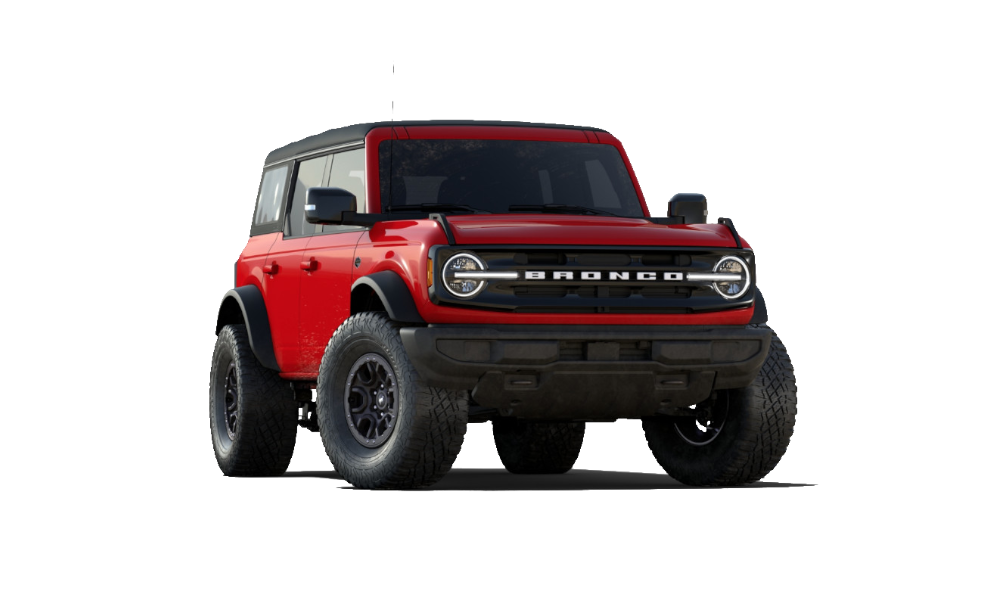
Let’s take a deep dive into the history of the Ford Bronco shall we? The Bronco was released in August of 1965, and was off to a middling start. The competition in the market around the small body, short wheelbase Sport Utility Vehicle was steep in the early days. It slowly grew in popularity after the first few early adopters got their cars out on the road. In the same time period, the world also found that the Bronco had a great capacity for racing. Specifically the Baja 1000. Many off-road racing fans know “Big-Oly” the heavily modified 1969 Bronco that won the Baja outright a couple of times. However fewer people know that there were actually attempts to run the grueling race with an unmodified Bronco in the early years as well. Ford even produced a special edition of the Bronco inspired by the designs of one such racer’s vehicle the 2025 Stroppe edition an orange-tone red, and white paint scheme with a black hood and blue roof. On the topic of special editions, there is a newly announced Bronco RTR (Ready To Rock), a partnership that Ford made with drift racer, and off-road racer Vaughn Gittin Jr. His racing Bronco, lovingly nicknamed “Brocky” which he ran in 2018; just one of his many appearances over the course of consistent appearances stretching back to 2016. The Bronco, across nearly all its variations has been a successful platform in motorsport.
Throughout the generations of Bronco, whether it be the 1965 to 1998 original run of the Bronco, or the modern 2021 to current run, one near constant feature of the Bronco would be that of having two different models available. The Bronco, and the Bronco II in the classic generations, and the Bronco, and Bronco Sport respectively. The Bronco II was added to the Ford vehicle lineup in 1984 as some purchasers wanted a Bronco in a smaller platform more befitting the original vehicle. The Bronco had grown, substantially, over the years. From a small yet capable SUV, to, in its main trim the Bronco was now measurably heavier, wider, longer, and taller. In fact, the Bronco was substantially taller, wider, and longer than its partner in the lineup, the Ford Explorer. While the modern Bronco, and Bronco Sport are somewhat a mirror to this dichotomy, the Bronco Sport is tuned more for city and highway travel, it is still capable of off-road travel. The Sport’s big brother, in a sense, is made, and is completely capable of just about any trail you could throw at it. All with minor to no modification required. In fact, the same Baja 1000 race has seen many basically stock (required safety modifications only) modern Broncos being run as a form of testing to make the vehicle more ready, and capable for your own pleasure.
There are really two pillars of the Bronco that have kept it both successful, and relevant in the market all these years. The removable roof, giving people the option of a vehicle closer to a pickup when needed, and the comfortability of an SUV when desired. The other? Mod-ability. Modifications have always been readily available for the Bronco. From the original release, and the stock straight six-cylinder being swapped out for a high-output 289 c.i. V8, removable door and roof kits and options, and a myriad of other options both factory, and aftermarket. While the removable roof is not an option currently available on the modern Bronco Sport, the full-size Bronco fully embodies both of those primary tenets. The Ford aftermarket catalog for the Bronco boasts many pages of modifications and at least 3 different options for roof coverings. Even the Bronco sport has many modification options available including roof racks, and front-end bumper impact bars.
If you have a Bronco and are interested in joining in the modified Bronco movement give our White’s Canyon Xtreme Truck Shop a visit and we’ll see what we can do for you!